Donating an existing life insurance policy to charity
The life insurance you bought while building your business may have a different role today. A loan may be repaid, a business partner bought out or your family less dependent on your income.
Donating an existing life insurance policy to charity may be worth exploring before cancelling coverage you no longer need. You do not need a history of charitable giving to consider this option, although the charity will need to understand your intentions and decide whether it can accept the gift.12
The starting point is not the size of the potential donation receipt. It is whether the policy still has a job to do for you, your family or your corporation, and which giving arrangement would best support your wealth, legacy and objectives.
The short answer
I would consider a policy donation when the coverage is genuinely surplus to your needs, the charitable goal is clear and there is a workable plan for any future premiums. I would be more cautious when the policy still supports family security, business obligations or an estate plan that has not been reviewed.
Transferring a policy to charity and naming a charity as beneficiary are different decisions. The first gives the charity ownership now; the second can leave you as owner, with a gift funded by the insurance proceeds after death.13
I would centre the comparison on whether the policy is fully paid up, who will fund any remaining premiums and whether usable donation relief during your lifetime or at death produces the better overall outcome. The largest receipt is not necessarily the arrangement that leaves your family and chosen charity in the strongest position.
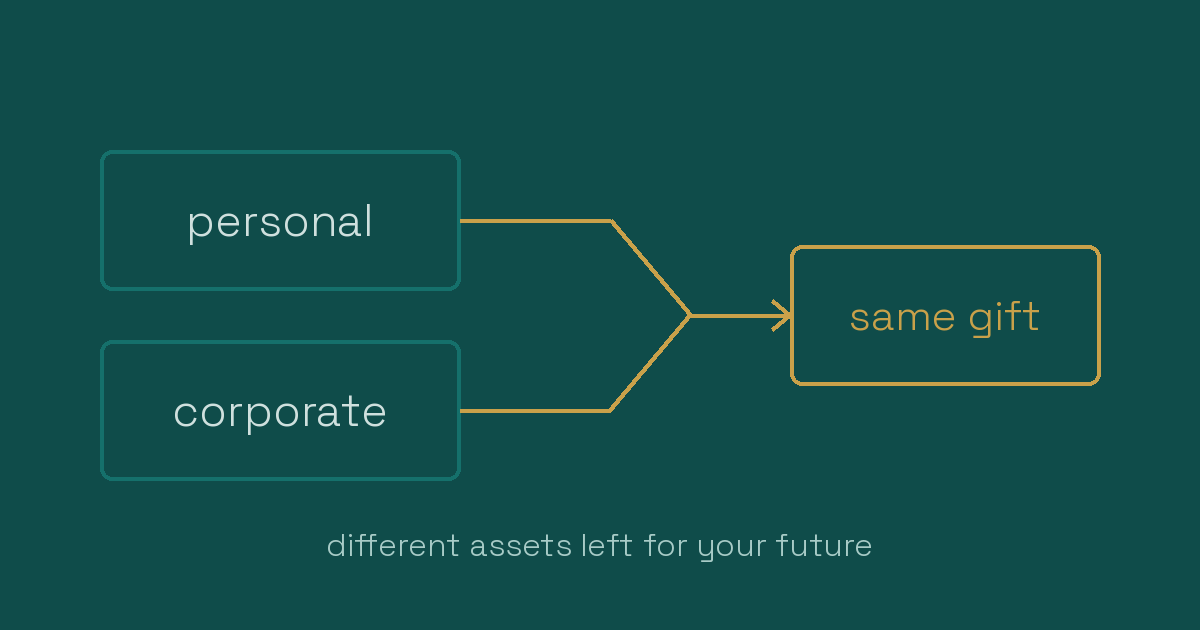
Our previous article, Choosing between personal and corporate charitable giving, compared which assets to give and which to preserve. Here, the same principle applies: an insurance policy should be considered alongside the rest of your financial plan, not treated as a separate tax opportunity.
Start with the policy's purpose
Consider a hypothetical business owner, David, who bought a permanent policy while his children were young and his company was carrying debt. Years later, the debt is repaid and his family has built substantial investments.
David is considering cancelling the policy because the original need has changed. Before doing so, I would review whether the coverage still helps fund taxes at death, provide liquidity for his estate or leave an inheritance without forcing the sale of other assets.
If those needs are already covered, the policy may be available for a different purpose. If they are not, donating it could create a gap that a donation receipt does not solve.
The comparison should therefore include keeping the policy, changing the coverage where the contract permits, surrendering it and exploring a charitable gift. A policy that no longer serves its original purpose is not necessarily a policy with no remaining value.
Donating an existing life insurance policy: two different routes
The first decision is whether you want to make a completed gift now or arrange a gift at death. The distinction affects control, the timing of the gift and the treatment of future premiums.135
Transfer ownership to the charity
An outright gift involves transferring ownership and making the charity the irrevocable beneficiary. CRA describes this as an absolute assignment: the complete transfer of the policy's rights, benefits and liabilities without conditions.1
That is a completed gift, not an arrangement under which you continue to control the policy. I would proceed only when you are comfortable making that commitment and the charity has confirmed it can accept the proposed gift.15
As the new owner, the charity takes over the policy, but who funds future premiums must be agreed before the transfer.112 You might continue funding them through further donations, or the charity might agree to pay them from its own resources; neither should be assumed.111
The transfer may support a donation receipt based on the policy's eligible value at that time. It does not automatically produce a receipt equal to the death benefit printed on the policy.12
Keep ownership and name the charity as beneficiary
Alternatively, you can keep the policy and designate the charity to receive proceeds at death.5 For David, this may be the route to examine if his giving goal is long-term but he is not ready to give away ownership today.
Simply naming a charity as beneficiary does not produce a current receipt for the policy or make the premiums you continue paying charitable donations.5 A qualifying payment to the charity at death can instead be treated as an estate donation, with the available claims depending on the estate-donation rules.3
If retaining flexibility matters, confirm that the beneficiary designation is revocable and review any existing restrictions. Keeping ownership is not the same as having unrestricted rights under every policy arrangement.
Separate the policy's value from the tax on its transfer
The donation receipt and the taxable policy gain are separate calculations. The receipt is governed by charitable-gift valuation rules, while the transfer is subject to the life-insurance disposition rules in the Income Tax Act.24
Three figures matter here:
- Cash surrender value: The amount available on surrendering the policy, subject to the contract and any applicable adjustments.4
- Adjusted cost basis: The policy's tax cost, calculated under the insurance rules rather than simply adding up the premiums paid.4
- Fair market value: The policy's assessed value for the gift, which is not necessarily the same as its cash surrender value. Relevant valuation factors can include the insured person's health and life expectancy, the policy terms and conversion rights.210
A simplified example
Suppose David owns the policy personally and has held it for 15 years. For illustration only, assume an independent valuation supports the following figures and the charity accepts the gift:
| Policy information | Hypothetical amount |
|---|---|
| Death benefit | $500,000 |
| Cash surrender value | $20,000 |
| Adjusted cost basis | $12,000 |
| Fair market value | $40,000 |
Assume an outright gift with no payment or other benefit to David, no policy loans and no special receipt-value limitation. These are invented figures to explain the mechanics, not a quote or an estimate of what a particular policy is worth.
Under those assumptions, the eligible donation amount would be $40,000, not the $500,000 death benefit.2 The transfer would also create an $8,000 income inclusion: the $20,000 surrender value less the $12,000 adjusted cost basis under the applicable disposition rules.4
That $8,000 is taxable income, not an $8,000 tax bill, and it is not a capital gain.4 David's actual tax result would depend on the tax on that income and how much of the donation credit he can use.3
The useful calculation is the combined result. Looking only at the donation receipt would leave out part of the transaction.
A valuation does not settle the receipt
Special rules can limit a gift's receiptable value to the lower of fair market value and the policy's adjusted cost basis. They can apply, for example, when the policy was acquired less than three years before the gift, or less than ten years before it when making a gift was one of the main reasons for acquiring it.2
Those are not the only circumstances requiring review. Ask the charity and your tax advisor to confirm the eligible receipt amount before treating an appraisal as an available tax benefit.12
Establish whether premiums remain and who will pay them
For David, a fully paid-up policy presents a different decision from one that requires payments for another 15 years. I would ask the insurer to confirm the contractual premium requirements, not rely only on what David is currently paying out of pocket.
There are three funding situations to separate:
- The policy is fully paid up: No further premiums are required for the paid-up coverage.13 Confirm whether this applies to all the coverage being donated, including any additional benefits.
- You continue funding premiums: You and the charity agree that you will make further contributions to keep the charity-owned policy in force. Qualifying amounts donated to the charity for premiums, or paid directly to the insurer at the charity's request or with its agreement, can be receipted as additional gifts.1
- The charity funds premiums: The charity accepts the policy on the basis that it will make the future payments.11 I would have that commitment documented, including how changing costs or an unexpectedly long payment period would be handled.
A policy on premium offset is not the same as fully paid-up coverage. Premium offset uses dividends or accumulated policy values to meet premiums that are still due; if those values are insufficient, out-of-pocket payments may need to resume.13
I would ask for an updated policy illustration showing guaranteed and non-guaranteed elements separately. If premiums remain, the gift agreement should address what happens if the intended funding stops, rather than leave either party assuming the other will pay.12
Donate a term policy that the charity converts and funds
A term policy generally does not build cash value, but that does not automatically rule it out as a charitable gift.711 Some term policies have conversion rights that allow a move to permanent coverage within specified limits and deadlines, potentially without new medical evidence.6
One option is to transfer an eligible term policy to a willing charity, which then converts it to permanent insurance and pays the premiums going forward. This depends on the insurer permitting the conversion and the charity accepting both the policy and the funding commitment.61112
Under that arrangement, the charity becomes the owner and beneficiary, while you remain the insured person if the policy covers your life.111 The death benefit is intended for the charity, not for you or your estate.
Suppose David also has a convertible term policy he no longer needs. If the charity accepts it and agrees to convert and fund it, he could make a gift without taking on the future permanent-policy premiums himself; the charity would assess the conversion cost and long-term commitment before agreeing.
I would confirm the transfer and conversion sequence, conversion deadline, premium schedule and eligible donation value before proceeding. In particular, have the tax advisor review whether conversion affects the applicable receipt-value rules rather than assuming a fair market value receipt is automatic.2
The end of an initial term can be a renewal point rather than the policy's final expiry.7 A renewal or conversion deadline is a reason to review the options promptly, not to rush into a donation.
Corporate ownership changes the comparison
If your corporation owns the policy, start with the company's position rather than applying a personal-gift example unchanged. A corporate donation generally produces a deduction in computing taxable income, while a personal donation generally produces a tax credit.83
I would review whether the policy still supports a shareholder agreement, debt repayment or the company's estate-planning role. I would also have the accountant calculate the transfer's tax consequences and when the corporation could use any donation deduction.
There is another important distinction: life-insurance proceeds received by a private corporation in consequence of death can contribute to its capital dividend account, subject to adjusted cost basis and other adjustments.9 If the corporation gives away the policy and is no longer entitled to the proceeds, do not carry that expected insurance-related CDA addition into the revised plan.9
In other words, compare what the company gives up as well as what it may deduct. A receipt does not replace the estate liquidity or shareholder-planning role the policy was intended to serve.
Compare lifetime relief with a gift of the death benefit
For David, the central comparison is between donating ownership now and retaining ownership while naming the charity to receive the death benefit. Both can support a charitable legacy, but they place the tax relief and any ongoing financial commitment at different points in his plan.135
Using the earlier illustration, transferring the policy could produce an eligible donation amount of $40,000 today, subject to the stated assumptions. Keeping ownership and directing the full $500,000 death benefit to the charity could instead support an estate donation based on the amount ultimately paid, subject to the estate-donation rules.3
The larger future receipt does not settle the decision. I would compare the tax relief that can actually be used, when it is available, any tax on a transfer and the cost of funding the policy along the way.
- Wealth during your lifetime: Under a transfer now, calculate the usable tax relief after any policy-disposition tax and include the premiums you still agree to fund. Then show how the resulting cash flow could support spending, investing or further giving.
- Wealth left to your family: Under a gift at death, estimate the donation relief available under the estate rules and the after-tax estate remaining for heirs. Compare that with the lifetime-transfer route, including any tax savings and premium savings retained and invested.
- The charitable legacy: Compare the amount and timing of the charity's expected benefit, allowing for any premiums the charity must fund itself. Transferring ownership now does not necessarily mean the charity receives the death benefit now; it may hold the policy until death.11
- Control and objectives: Consider whether you are ready to make a completed gift or want to retain ownership and flexibility. Include the family's needs and the purpose of the charitable gift, not just the tax calculation.
I would run both routes to the same assumed ages at death and test more than one lifespan. An earlier death, a longer premium-paying period or different investment results can change the comparison, so I would not present one forecast as a guaranteed winner.
For a fully paid-up policy, the premium-funding question may already be settled, leaving the timing of relief, control and legacy as the main differences. Where the charity agrees to take over substantial future premiums, those payments no longer coming from David's resources belong in the comparison too.
The outcome I would want is clear: what David can use during his lifetime, what remains for his family and what the charity receives under each route. The insurance advisor, accountant and charity should be working from the same assumptions before anything is signed.
The bottom line
An existing life insurance policy may deserve a second look before it is cancelled. But the strongest reason to donate it is that it fits your charitable goals and is no longer needed for another part of your plan, not simply that a receipt may be available.
Confirm whether the policy is fully paid up, who will fund any remaining premiums and whether donation relief during your lifetime or at death best serves your plan. Choose by the overall effect on your wealth, your family's inheritance and your charitable legacy, not the size of the receipt alone.
Matthew Arthur, CFP®, CIM® · matthew@profittoprosperity.ca
Matthew Arthur, CFP®, CIM® · matthew@profittoprosperity.ca · Subscribe to the newsletter
Common questions
Will I receive a donation receipt for the full death benefit?
Not simply because you transfer the policy during your lifetime. The receipt is based on the eligible value of the policy at the time of the gift, subject to the applicable valuation rules.12
Can donating the policy create taxable income?
Yes, the transfer can create a taxable policy gain under the life-insurance disposition rules.4 Have that calculation prepared alongside the donation calculation rather than assuming the gift itself is tax-free.
Can my estate claim the death benefit after I have already donated ownership?
Do not assume a second donation receipt will arise at death. CRA's beneficiary-designation donation rules exclude an arrangement where the qualified donee is already the policyholder or assignee of an interest under the policy.3
Can I donate a term policy?
Yes, where the charity accepts the policy and the arrangement meets the applicable requirements.111 One option is for the charity to take ownership, convert eligible term coverage to permanent insurance and fund future premiums, while you remain the insured person.61112
Who pays the premiums after I transfer ownership?
That must be agreed with the charity before the transfer: you may continue funding premiums, or the charity may agree to pay them.111 If the coverage is genuinely fully paid up, no further premiums are required for that coverage; a non-guaranteed premium-offset arrangement is different.13
Is a receipt today better than a donation at death?
Neither is automatically better. Compare the usable tax relief, its timing, future premium commitments, retained control and the projected amounts available to your family and the charity.
Primary sources
Reviewed November 14, 2026. David and all policy amounts are hypothetical; the illustration explains the mechanics rather than predicting a valuation or tax saving.
- Canada Revenue Agency: Life insurance policy, CSP-L02. Absolute assignment, irrevocable beneficiary status, receipting considerations and qualifying premium donations. Read its valuation summary with the detailed conditions in source 2.
- Canada Revenue Agency: Income Tax Folio S7-F1-C1, Split-receipting and Deemed Fair Market Value. Eligible gift amounts and the deemed-value rules, particularly paragraphs 1.26–1.28.
- Canada Revenue Agency: Gifts and Income Tax, Guide P113. Personal donation claims, estate donations and life-insurance designation donations. The guide currently available is titled Gifts and Income Tax 2025; no 2026 tax-rate estimate is used in this article.
- Income Tax Act, section 148. Policy disposition income under subsection 148(1), gift-transfer proceeds under subsection 148(7), and the definitions of adjusted cost basis and value under subsection 148(9). The example assumes an ordinary personally owned policy subject to these rules, with no loans, consideration or other complications.
- Heart & Stroke: Gift of life insurance and its life-insurance giving guide, in French. Charity acceptance, ownership transfer versus beneficiary designation, and the difference in premium receipting. This is a recipient's guidance, not a guarantee that another charity will accept a policy.
- Sun Life: Convert term to permanent life insurance. Contract-dependent conversion rights, deadlines, medical-evidence requirements and premium implications. Canada Life's My Par Gift advisor FAQ also documents a product-specific route in which term ownership transfers to the charity before conversion; its single-premium product requirements are not presented as universal conversion rules.
- Canada Life: Term life insurance. Term coverage, absence of cash value, renewal and final expiry. The article does not apply this insurer's specific product ages or terms to every policy.
- Canada Revenue Agency: T2 Corporation Income Tax Guide, Chapter 3. Corporate charitable-donation deductions, income limits and carryforwards.
- Canada Revenue Agency: Income Tax Folio S3-F2-C1, Capital Dividends. Life-insurance proceeds and the CDA, particularly paragraphs 1.59–1.60.5. The article's planning caution follows the requirement to assess the corporation's entitlement to and receipt of proceeds; complex collateral or constructive-receipt arrangements require separate review.
- Canada Revenue Agency: IC89-3, Policy Statement on Business Equity Valuations. Paragraphs 40–41 discuss relevant life-insurance valuation factors in the corporate-share valuation context. CRA's life-insurance gift policy also references this circular; it is not a standalone formula for a charitable receipt.
- Loeys-Dietz Syndrome Foundation Canada: Donation options and its existing-policy donation guide. A primary example of a charity considering term and permanent policies, becoming owner and beneficiary, and offering an arrangement in which it pays future premiums. Its acceptance remains subject to review; its promotional valuation ranges are not used in this article.
- Canadian Association of Gift Planners: Insurance Donations, Guidelines for Canadian Charities. Donor intent and relationships, gift agreements, premium-funding risk, independent policy review and term-to-permanent conversion considerations, particularly pages 6–10.
- Canada Life: Premium offset frequently asked questions and My Par Gift resources for charities. The difference between continuing premiums funded through non-guaranteed policy values and fully paid-up coverage requiring no further premiums. The latter page describes a specific single-premium product, not the status of any reader's existing policy.
This article is general education, not individual tax, legal, or investment advice. Your situation is specific. The right structure depends on your numbers, your risk, and your goals. Talk to your accountant and advisor before acting.