Choosing between personal and corporate charitable giving
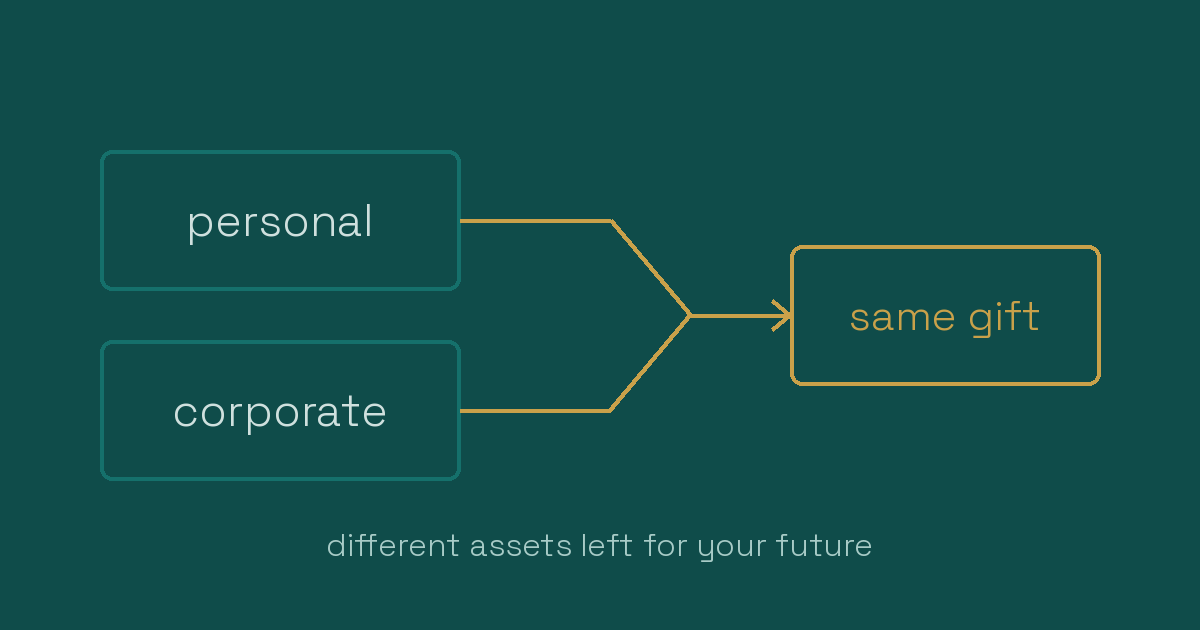
When you have money invested personally and inside a corporation, choosing how to fund a charitable gift is about more than the donation receipt. You are also choosing which assets to give away and which to keep for your future.
A personal donation may produce a larger immediate tax reduction than the same corporate donation.12 But that does not automatically mean you should use your personal money.
If the corporate money would eventually be paid to you as a taxable dividend, that later personal tax belongs in the comparison too.8 The useful question is which route leaves you and the company in the stronger position after the gift, not which tax return shows the larger saving.
The short answer
I would give the corporate route a close look when you have genuine corporate surplus, can use the donation deduction and want to preserve personal investments for other goals. I would give the personal route a close look when the assets you intend to donate are already held personally, the personal tax relief can be used sooner, or the business has a better use for its cash.
Those are starting points, not automatic answers. The decision should connect three things: the tax cost of moving money, the value of the assets you keep invested and the timing of the donation relief.
Our earlier article, How to donate to charity through your corporation, explains the corporate mechanics. This article focuses on choosing between the routes.
Start with the tax difference, but do not stop there
A personal donation generally produces a credit, which reduces your personal income-tax bill.1 A corporate donation generally produces a deduction, which reduces the income on which the company pays tax.2
Here is a simplified Ontario 2026 example using a $25,000 cash gift. The individual has $150,000 of taxable income; the corporation has $750,000 of qualifying active-business profit before the donation deduction, after its expenses and any owner compensation.
| Same $25,000 gift | Made personally | Made by the corporation |
|---|---|---|
| Amount received by the charity | $25,000 | $25,000 |
| Immediate income-tax saving | Approximately $11,553 345 | $6,625 267 |
| Gift less that tax saving | Approximately $13,447 from personal wealth | $18,375 from corporate wealth |
The personal credit includes federal, Ontario and Ontario surtax effects; the corporate saving is $25,000 multiplied by 26.5%.3456 We assume sufficient tax and income to use the full relief, no other donations or unusual credits, and the full corporate small-business limit available.
The table makes the personal gift look less expensive. However, a dollar already in your personal account and a dollar still inside your company are not necessarily worth the same amount to you personally.
Bring the eventual withdrawal into the comparison
To illustrate that distinction, suppose the additional corporate money kept under the personal-gift route would ultimately be paid as a taxable dividend. Assume, purely for this illustration, that the personal tax on that extra payment would be 35%.
Under the corporate-gift route, the company has $18,375 less after allowing for its donation tax saving. At the assumed 35% withdrawal tax, that balance would have represented approximately $11,944 of personal money: $18,375 multiplied by 65%.
That is less than the approximately $13,447 personal cost in the first column. In this stripped-down comparison, the corporate route leaves more combined after-tax wealth, even though its immediate donation tax saving is smaller.
The 35% is a hypothetical effective rate on the additional dividend, not the actual rate calculated for someone earning $150,000. This illustration ignores investment growth and the time value of money, assumes all of that additional balance is distributed as a taxable dividend, and assumes no further corporate tax refund or tax-free payment.
It explains why the eventual withdrawal matters; it does not settle a long-term investment decision. The actual payment method, dividend type and tax circumstances need to be established rather than assumed.8
Decide which investments you would rather preserve
Suppose you could donate corporate surplus without disturbing your personal portfolio. I would compare that with making the gift personally and leaving more money invested in the company.
The comparison should follow both paths to the same future date, using comparable investment risks and realistic spending needs. It should include the growth after tax, what happens to the donation tax savings and any tax when the remaining corporate money is eventually paid out.
Personal money is not all the same
If the personal alternative is withdrawing from a TFSA, the assets you would preserve generally have tax-free investment growth and withdrawals.10 That gives me a reason to examine a corporate-funded gift before using the TFSA, rather than looking only at the donation credit.
A TFSA withdrawal is not a permanent loss of the withdrawn contribution room: that amount is generally added back the following calendar year.10 But restoring room is different from having money available to refill the account.
An RRSP is different again: ordinary withdrawals generally create taxable income.11 I would therefore not treat a proposed RRSP-funded donation as equivalent to using cash already sitting in a personal bank account.
Corporate money is not automatically the worse investment pool
Preserving personal investments is not a reason to assume every corporate dollar should be donated. I would also compare the corporation's intended investments, the expected holding period and the owner's likely withdrawal plan.
For example, a near-term withdrawal and a retirement withdrawal many years away deserve different calculations. The future tax rate, investment returns and how long tax is deferred can change the result, so I would not carry the simple 35% illustration forward as though it were a forecast.
The practical objective is to preserve the mix of personal and corporate assets that best supports your plan. It is not simply to keep the account with the larger balance today.
Compare the asset, not just the account
A personal gift of an investment that has risen substantially in value may deserve comparison with a corporate cash gift. The reverse is also worth testing when the appreciated investment is held by the company.
Certain eligible securities donated directly can receive favourable capital-gain treatment that does not apply simply because an investment is sold and the proceeds are later donated.12 Selling first can therefore change the transaction you are comparing.
I would review the available investments before deciding that the donation must be cash. The account owner, the investment's original tax cost and the recipient's ability to accept the asset all belong in that review.
Match the route to the situation
These are circumstances that would change where I start the comparison. Each points to a route worth investigating, not a guaranteed winner.
| Your situation | Route I would examine closely | What could change the answer |
|---|---|---|
| The company has surplus cash and can use the deduction; a personal gift would draw down investments you want to retain. | Corporate giving, to preserve the personal portfolio. | The growth expected in each account, future withdrawal tax and the purpose of the corporate funds. |
| The company cannot use much of the deduction soon, while you have personal cash and can use the personal credit now. | Personal giving, because usable relief today may be more valuable than uncertain relief later. | Expected future corporate profits, when the deduction could be claimed and the cost of waiting. |
| You own appreciated securities personally that the charity can accept. | A direct personal securities gift, compared with a corporate cash gift. | The investment's tax cost, the full personal tax calculation and any suitable corporate assets. |
| The business needs capital for an acquisition, debt repayment or an important operating commitment, while the personal gift fits your plan. | Personal giving, to avoid weakening the business's financial position. | Financing costs, liquidity requirements and the effect on your personal goals. |
The tax principles behind the donation and timing comparisons are explained in CRA's personal and corporate donation guidance.12 The route preferences above are a planning framework, not conclusions about an individual reader.
Check the value and timing of the corporate deduction
In the $750,000-profit example, the $25,000 donation deduction reduces income otherwise taxed at the general rate.267 If a larger deduction reaches income taxed at the lower small-business rate, the next dollar deducted generally saves less tax under those assumptions.
The $500,000 limit is not an all-or-nothing cutoff: an otherwise eligible company can still receive the lower rate on its first $500,000 when its total profit is higher.7 I would not increase a gift simply to bring profit below that figure, or assume that a gift restores a limit reduced under separate rules.
Ordinary unused donation amounts can generally be carried forward for five following tax years, both personally and corporately.29 For a 2026 gift by an individual or a calendar-year corporation, that generally means through 2031.
That flexibility is useful, but future relief is not the same as a saving available today. I would compare when each route can use the gift, whether only part should be claimed now and the risk that an unused amount expires.
Put both routes into the same financial plan
The comparison I would want is not two separate tax estimates. It is a before-and-after view showing what the charity receives and what remains available to you and the business.
- Today: Identify the asset being given, any sale or withdrawal required, and the tax relief that can actually be used.
- While invested: Compare the remaining personal and corporate portfolios on a consistent basis, including taxes, costs and what happens to the tax savings.
- When you need the money: Include the intended way of accessing the corporate assets, rather than treating the full company balance as spendable personal cash.
This is where the compensation discussion in How to pay yourself for the rest of the year connects with charitable giving. The advisor and accountant should be comparing the same transactions and assumptions, not answering different parts of the question in isolation.
The bottom line
If the money will eventually come out of the corporation, that future withdrawal belongs in today's giving decision. A corporate gift can be worth considering even when the personal donation credit looks larger, particularly when it helps preserve personal investments that serve your plan.
But personal giving can also be the better fit when it uses the more suitable asset, provides usable relief sooner or protects capital the business needs. Choose the route by the complete outcome, not the largest tax break shown on one return.
Matthew Arthur, CFP®, CIM® · matthew@profittoprosperity.ca · Subscribe to the newsletter
Common questions
Is it better to keep my personal investments and donate corporately?
It can be, particularly when the company has genuine surplus and can use the deduction. Compare the personal investments preserved with the corporate investments forgone, including growth after tax and the eventual withdrawal plan.
Does a larger personal donation credit mean I should donate personally?
Not by itself. If funding the gift requires a taxable corporate payment or an ordinary RRSP withdrawal, that additional income-tax effect must also be included.811
Primary sources
Reviewed November 2, 2026. The route preferences are educational considerations; the examples are not personalized tax calculations or recommendations.
-
Canada Revenue Agency: Gifts and Income Tax, Guide P113. Personal donation credits, claim limits and qualifying securities gifts. The currently available guide is titled Gifts and Income Tax 2025; the 2026 illustration uses the numerical sources below.
-
Canada Revenue Agency: T2 Corporation Income Tax Guide, Chapter 3. Corporate donation deductions, income limits, carryforwards and gifts of capital property.
-
Income Tax Act, section 118.1. Federal donation-credit formula. In the example, the federal credit is $28 on the first $200 and $7,192 on the remaining $24,800.
-
Canada Revenue Agency: Ontario payroll tables, January 2026 general information. Federal lowest rate, Ontario brackets, basic personal amount and surtax thresholds. The illustration assumes Ontario tax remains above both surtax thresholds after the donation credit.
-
Ontario 2026 Fall Statement: Descriptions of tax provisions. Ontario donation-credit rates. The example's provincial credit is $2,777.78 before surtax effects, with a $1,555.56 surtax reduction, for a total federal and provincial saving of $11,553.34.
-
Canada Revenue Agency: Corporation tax rates. The illustrated Ontario general active-business rate combines 15% federal tax and 11.5% Ontario tax. The $750,000 is qualifying profit, not revenue, and the full $500,000 business limit is assumed available.
-
Canada Revenue Agency: T2 Corporation Income Tax Guide, Chapter 4. Small-business-deduction calculation and factors affecting the available business limit.
-
Canada Revenue Agency: Taxable dividends from Canadian corporations. Personal taxation of eligible and other-than-eligible dividends. The 35% withdrawal tax in the article is an explicit hypothetical assumption, not a rate quoted from this page.
-
Canada Revenue Agency: Donations and gifts, How to claim. Partial personal claims and ordinary five-year carryforwards.
-
Canada Revenue Agency: What is a TFSA and Withdrawing from a TFSA. General tax-free treatment and replacement of withdrawn contribution room in the following calendar year.
-
Canada Revenue Agency: Making withdrawals from an RRSP. General taxation of ordinary RRSP withdrawals.
This article is general education, not individual tax, legal, or investment advice. Your situation is specific. The right structure depends on your numbers, your risk, and your goals. Talk to your accountant and advisor before acting.