Excess cash in your corporation
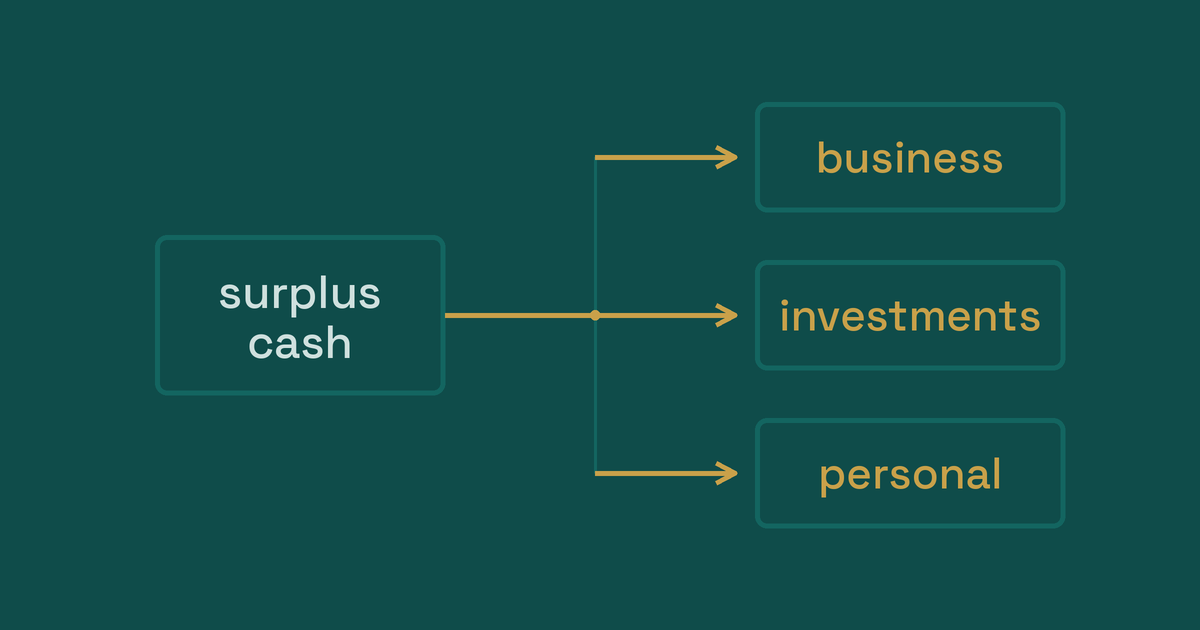
Your corporation has money left after its operating needs, tax obligations and planned spending. You do not need all of it personally, but leaving it in the business account no longer feels like a complete plan.
The question is not simply which investment to buy. It is what that money should accomplish, where it should be held, and how you or your family will eventually use it.
The short answer
I would approach excess corporate cash as a series of connected decisions. Start with the purpose of the money, then compare the structure, investments and tax consequences that support that purpose.
Establish what is genuinely available
Before deciding what to do with the surplus, separate money the business needs from money available for longer-term planning. Consider operating commitments, taxes, debt payments, seasonal fluctuations and spending you have already approved.
This does not need to become an exercise in finding one perfect reserve amount. The useful distinction is between money with a defined business purpose and money that remains after those purposes have been funded.
For example, you might divide the balance into three categories:
- Operating cash: Money needed to run the business and meet known obligations.
- Planned commitments: Money assigned to a specific purchase, expansion or other foreseeable expense.
- Long-term surplus: Money available to support investments, personal wealth or a future transfer to family.
Put an amount and a likely timeline beside each category. If a balance is labelled “just in case,” identify what it is protecting against before committing it elsewhere.
This is a planning exercise, not a tax classification. Ask your accountant to assess separately whether the cash qualifies as an active-business asset for any share-sale planning.
Review where the money should sit
Once you have identified the longer-term surplus, review whether the operating company is the right place to keep it. Start with the existing structure rather than assuming another corporation is the answer.
I would frame the discussion around three possibilities:
- Keep the current arrangement: Compare its simplicity with the business risks, future transactions and personal plans you need it to accommodate.
- Review a holding company or another entity: Identify the specific purpose of separating assets, then assess the transfer, ownership, legal considerations and ongoing costs.
- Review the broader ownership plan: If a sale or family succession is becoming relevant, ask whether an estate freeze, trust or another share arrangement deserves consideration alongside the cash decision.
A holding company should solve an identified problem, not become the default response to a large balance. Ask what it changes, what it costs and what remains unchanged.
Do not treat moving money between companies as an ordinary bank transfer with no tax consequences: intercorporate dividends have specific deduction rules, and Part IV tax may also need to be considered.1 Have your accountant and lawyer confirm the proposed steps before implementing a transfer.
Compare uses before choosing products
The surplus does not have to serve one purpose. Compare the alternatives before deciding how much belongs in each.
- Business growth and debt: Compare reinvestment, acquisitions and debt repayment with retaining flexibility or building wealth outside the operating business. Include the possibility that the business already accounts for a substantial share of your financial exposure.
- An investment portfolio: Consider savings accounts, GICs, bonds, mutual funds, ETFs or individual stocks against the timeline and risk assigned to the money. Ask about access, diversification, fees and the tax character of expected returns rather than choosing by product label.
- Property or another business: Assess financing, management responsibilities, future funding needs and your ability to exit. Compare those demands with the work and exposure you already have.
- Insurance and protection: Where there is a business, family or estate need, compare term or permanent coverage and the appropriate ownership arrangement. If permanent insurance is being considered as a use of long-term surplus, examine premiums, policy values and access conditions alongside the protection it provides.
The point is not to assemble one of everything. It is to distinguish money you may need to access from money you can commit for longer, and then compare suitable alternatives.
For every option, ask the same question: what happens if the business needs this money sooner than expected?
Separate investment tax from the passive-income rule
Corporate investing requires two separate tax discussions: how the investment return is taxed, and whether investment income affects the amount of active business income eligible for the federal small-business deduction.2 Ask your accountant to model both rather than focusing only on the investment’s advertised return.
For a Canadian-controlled private corporation, the federal business limit is reduced as adjusted aggregate investment income across the associated corporate group rises above $50,000, with the passive-income reduction fully eliminating the limit at $150,000. The calculation generally uses the corporations’ taxation years ending in the preceding calendar year, not simply the current bank balance.3
For illustration, assume a full $500,000 federal business limit before reductions and no larger taxable-capital reduction. At $100,000 of adjusted aggregate investment income, the remaining federal business limit would be $250,000.3
That is a reduction in an income limit, not a $250,000 tax bill. Its practical effect depends on the corporation’s qualifying active business income and the other applicable rules.2
Moving the investments into an associated holding company does not create another $50,000 threshold, because the calculation combines associated corporations’ adjusted aggregate investment income.3 Provincial treatment also matters: Ontario does not apply this federal passive-income reduction to its provincial small-business limit.4
The planning question is therefore not “How do I avoid earning investment income?” It is “What does each option leave after tax, and how does it fit the rest of the business?”
Compare corporate wealth with personal wealth
Do not stop the comparison at the amount the corporation can invest today. Ask for a side-by-side projection of keeping the money corporate versus withdrawing an appropriate amount to support personal goals.
That comparison should include:
- Personal priorities: Retirement spending, debt repayment and other needs outside the company.
- Account choices: Available RRSP or TFSA room and whether contributions belong in the plan.
- Withdrawal timing: The proposed payment method, current tax cost and future access to the money.
- The final outcome: What remains available for you or your family after the relevant taxes, costs and withdrawals.
There may be a role for both corporate and personal investing. The aim is to give each pool of money a purpose rather than deciding that everything must remain inside the corporation or everything must come out.
Look ahead to a sale or succession
If selling your shares is a possibility, review the corporation’s asset mix before a transaction becomes imminent. Qualification for the lifetime capital gains exemption on small-business shares includes asset-use and ownership tests, with requirements at the time of sale and during the preceding 24 months.5
That makes share-sale eligibility a separate review from the passive-income calculation. Do not assume that staying below an investment-income threshold establishes that the shares qualify, or that a last-minute transfer will resolve every requirement.
Estate planning deserves the same forward view. At death, capital property, including shares, is generally subject to a deemed disposition at fair market value, although a qualifying spousal transfer or another exception may change the immediate treatment.6
Ask your advisors to map the complete path: the shareholder’s tax position, what happens if corporate investments are later sold, and how funds would reach beneficiaries. Discuss liquidity, ownership, insurance and any post-mortem planning together rather than assuming one decision addresses all of them.
Give the surplus a defined purpose
For your next planning discussion, bring the cash balance, existing investments, anticipated business spending and personal priorities. Then work through four decisions:
- Amount: What is genuinely available beyond the business’s needs?
- Ownership: Where should it be held, and why?
- Purpose: What should it fund, and when?
- Outcome: How will it eventually reach you or your family?
You do not need to commit every dollar immediately. You do need a reason for what remains accessible, what gets invested and what is set aside for longer-term commitments.
The bottom line
Excess corporate cash is not just an investment decision. It is an opportunity to connect the value your business has created with the life, retirement and legacy you want it to support.
Matthew Arthur, CFP®, CIM® · matthew@profittoprosperity.ca · Subscribe to the newsletter
Common questions
How much cash is too much to leave in my corporation?
There is no single balance that answers that for every business. Start with operating obligations, taxes, seasonal needs and planned spending; the amount left over is what deserves a longer-term plan. A planning reserve is not automatically the same as cash that qualifies as an active-business asset for tax purposes.
Do I need a holding company before investing corporate cash?
Not necessarily. Compare the existing structure with a holding company based on the purpose of separating assets, the legal and tax implications, and the ongoing costs. A second corporation should address a specific need rather than become a prerequisite assumed for every owner.
Does the $50,000 passive-income rule limit how much I can invest?
No. It concerns adjusted aggregate investment income, not the cash balance or portfolio value. The amount and character of income generated by investments are relevant to that calculation, including income across associated corporations.3
Will moving the investments to a holding company avoid the rule?
Not if the operating company and holding company are associated for this purpose. Their AAII is combined for the calculation. A holding company may serve other objectives, but it does not automatically provide another passive-income threshold.3
Should I take the money out and invest personally instead?
Compare both routes using your own tax position, available registered-account room, personal needs and investment horizon. Include the cost of withdrawing money and the eventual after-tax outcome, rather than comparing only the starting account balances.
Can excess cash affect a future sale of my business?
Yes, it can affect whether the shares meet the asset-use requirements for the lifetime capital gains exemption. The rules consider more than the balance sheet on the sale date.5 Have the asset mix reviewed early rather than assuming it can all be addressed immediately before a transaction.
Primary sources
The tax rules discussed above are supported by the following Government of Canada publications. Review the current rules and your circumstances before relying on a threshold or implementing a transaction.
- T2 Corporation Income Tax Guide: deductions in computing taxable income, Canada Revenue Agency.
- T2 Corporation Income Tax Guide: small-business deduction, Canada Revenue Agency.
- Income Tax Act, section 125, Department of Justice Canada.
- Ontario small-business deduction, Canada Revenue Agency.
- Capital Gains guide, Canada Revenue Agency.
- Taxable capital gains on property, investments and belongings, Canada Revenue Agency.
This article is general education, not individual tax, legal, or investment advice. Your situation is specific. The right structure depends on your numbers, your risk, and your goals. Talk to your accountant and advisor before acting.